Kamis, 23 Juni 2011

Club Kewirausahaan, Ekonomi, Perbankan dan Akuntansi Syariah

Pengasuh: Uman Miftah S.
(Indonesian Islamic University, Yogjakarta)

Prinsip perbankan syariah

Prinsip syariah adalah aturan perjanjian berdasarkan hukum Islam antara bank dan pihak lain untuk penyimpanan dana dan/atau pembiayaan kegiatan usaha, atau kegiatan lainnya yang sesuai dengan syariah.

Beberapa prinsip/ hukum yang dianut oleh sistem perbankan syariah antara lain

  • Pembayaran terhadap pinjaman dengan nilai yang berbeda dari nilai pinjaman dengan nilai ditentukan sebelumnya tidak diperbolehkan.
  • Pemberi dana harus turut berbagi keuntungan dan kerugian sebagai akibat hasil usaha institusi yang meminjam dana.
  • Islam tidak memperbolehkan "menghasilkan uang dari uang". Uang hanya merupakan media pertukaran dan bukan komoditas karena tidak memiliki nilai intrinsik.
  • Unsur Gharar (ketidakpastian, spekulasi) tidak diperkenankan. Kedua belah pihak harus mengetahui dengan baik hasil yang akan mereka peroleh dari sebuah transaksi.
  • Investasi hanya boleh diberikan pada usaha-usaha yang tidak diharamkan dalam islam. Usaha minuman keras misalnya tidak boleh didanai oleh perbankan syariah.

Prinsip perbankan syariah pada akhirnya akan membawa kemaslahatan bagi umat karena menjanjikan keseimbangan sistem ekonominya[1].

Komentar: Hal ini sangat disayangkan karena kurangnya pengetahuan tentang prinsip tersebut sehingga masih banyak masyarakat yang kurang percaya dan kurang merasa mudah menggunakan fasilitas-fasilitas yang terdapat dalam prinsip-prinsip Bank Syari'ah. Didalam perbankaqn syari'ah telah diatur berbagai macam transaksi yang tidak merugikan bagi kedua pihak. Karena jika sampai ada yang dirugikan dan dirugikan maka sudah melanggar ajaran Islam itu sendiri. Prinsip perbankan syari'ah itu sendiri bersumber dari Al-Qur'an dan Hadits.


Wikipedia


Senin, 20 Juni 2011

The Manbaul Ullum Digital Library


Visi

Share Knowledge

Misi

Reading, Writing, Researching

Program

Pengumpulan Buku-buku Bermutu

Program 1000 Buku untuk The Manbaul Ulum University.


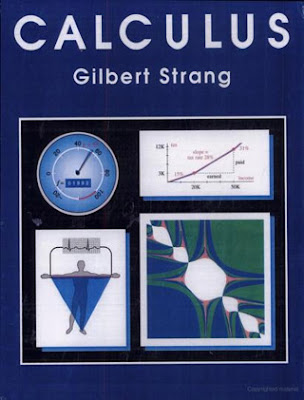
OCW is pleased to make this textbook available online. Published in 1991 and still in print from Wellesley-Cambridge Press, the book is a useful resource for educators and self-learners alike. It is well organized, covers single variable and multivariable calculus in depth, and is rich with applications. There is also an online Instructor's Manual and a student Study Guide.


Textbook Components

  • Table of Contents (PDF)
  • Answers to Odd-Numbered Problems (PDF)
  • Equations (PDF)


ChapterSFILES
1: Introduction to Calculus, pp. 1-43

1.1 Velocity and Distance, pp. 1-7
1.2 Calculus Without Limits, pp. 8-15
1.3 The Velocity at an Instant, pp. 16-21
1.4 Circular Motion, pp. 22-28
1.5 A Review of Trigonometry, pp. 29-33
1.6 A Thousand Points of Light, pp. 34-35
1.7 Computing in Calculus, pp. 36-43

Chapter 1 - complete (PDF - 4.1 MB)

Chapter 1 - sections:

1.1 - 1.4 (PDF - 2.8 MB)
1.5 - 1.7 (PDF - 1.6 MB)

2: Derivatives, pp. 44-90

2.1 The Derivative of a Function, pp. 44-49
2.2 Powers and Polynomials, pp. 50-57
2.3 The Slope and the Tangent Line, pp. 58-63
2.4 Derivative of the Sine and Cosine, pp. 64-70
2.5 The Product and Quotient and Power Rules, pp. 71-77
2.6 Limits, pp. 78-84
2.7 Continuous Functions, pp. 85-90

Chapter 2 - complete (PDF - 4.3 MB)

Chapter 2 - sections:

2.1 - 2.4 (PDF - 2.6 MB)
2.5 - 2.7 (PDF - 2.0 MB)
3: Applications of the Derivative, pp. 91-153

3.1 Linear Approximation, pp. 91-95
3.2 Maximum and Minimum Problems, pp. 96-104
3.3 Second Derivatives: Minimum vs. Maximum, pp. 105-111
3.4 Graphs, pp. 112-120
3.5 Ellipses, Parabolas, and Hyperbolas, pp. 121-129
3.6 Iterations x[n+1] = F(x[n]), pp. 130-136
3.7 Newton's Method and Chaos, pp. 137-145
3.8 The Mean Value Theorem and l'Hopital's Rule, pp. 146-153

Chapter 3 - complete (PDF - 5.9 MB)

Chapter 3 - sections:

3.1 - 3.4 (PDF - 3.2 MB)
3.5 - 3.8 (PDF - 3.3 MB)
4: The Chain Rule, pp. 154-176

4.1 Derivatives by the Charin Rule, pp. 154-159
4.2 Implicit Differentiation and Related Rates, pp. 160-163
4.3 Inverse Functions and Their Derivatives, pp. 164-170
4.4 Inverses of Trigonometric Functions, pp. 171-176

Chapter 4 - complete (PDF - 2.0 MB)

Chapter 4 - sections:

4.1 - 4.2 (PDF - 1.0 MB)
4.3 - 4.4 (PDF - 1.2 MB)
5: Integrals, pp. 177-227

5.1 The Idea of an Integral, pp. 177-181
5.2 Antiderivatives, pp. 182-186
5.3 Summation vs. Integration, pp. 187-194
5.4 Indefinite Integrals and Substitutions, pp. 195-200
5.5 The Definite Integral, pp. 201-205
5.6 Properties of the Integral and the Average Value, pp. 206-212
5.7 The Fundamental Theorem and Its Consequences, pp. 213-219
5.8 Numerical Integration, pp. 220-227

Chapter 5 - complete (PDF - 4.8 MB)

Chapter 5 - sections:

5.1 - 5.4 (PDF - 2.2 MB)
5.5 - 5.8 (PDF - 2.8 MB)
6: Exponentials and Logarithms, pp. 228-282

6.1 An Overview, pp. 228-235
6.2 The Exponential e^x, pp. 236-241
6.3 Growth and Decay in Science and Economics, pp. 242-251
6.4 Logarithms, pp. 252-258
6.5 Separable Equations Including the Logistic Equation, pp. 259-266
6.6 Powers Instead of Exponentials, pp. 267-276
6.7 Hyperbolic Functions, pp. 277-282

Chapter 6 - complete (PDF - 4.9 MB)

Chapter 6 - sections:

6.1 - 6.4 (PDF - 3.0 MB)
6.5 - 6.7 (PDF - 2.2 MB)
7: Techniques of Integration, pp. 283-310

7.1 Integration by Parts, pp. 283-287
7.2 Trigonometric Integrals, pp. 288-293
7.3 Trigonometric Substitutions, pp. 294-299
7.4 Partial Fractions, pp. 300-304
7.5 Improper Integrals, pp. 305-310

Chapter 7 - complete (PDF - 2.6 MB)

Chapter 7 - sections:

7.1 - 7.3 (PDF - 1.7 MB)
7.4 - 7.5 (PDF - 1.0 MB)
8: Applications of the Integral, pp. 311-347

8.1 Areas and Volumes by Slices, pp. 311-319
8.2 Length of a Plane Curve, pp. 320-324
8.3 Area of a Surface of Revolution, pp. 325-327
8.4 Probability and Calculus, pp. 328-335
8.5 Masses and Moments, pp. 336-341
8.6 Force, Work, and Energy, pp. 342-347

Chapter 8 - complete (PDF - 3.4 MB)

Chapter 8 - sections:

8.1 - 8.3 (PDF - 1.7 MB)
8.4 - 8.6 (PDF - 2.0 MB)
9: Polar Coordinates and Complex Numbers, pp. 348-367

9.1 Polar Coordinates, pp. 348-350
9.2 Polar Equations and Graphs, pp. 351-355
9.3 Slope, Length, and Area for Polar Curves, pp. 356-359
9.4 Complex Numbers, pp. 360-367

Chapter 9 - complete (PDF - 1.7 MB)

Chapter 9 - sections:

9.1 - 9.2 (PDF)
9.3 - 9.4 (PDF - 1.0 MB)
10: Infinite Series, pp. 368-391

10.1 The Geometric Series, pp. 368-373
10.2 Convergence Tests: Positive Series, pp. 374-380
10.3 Convergence Tests: All Series, pp. 325-327
10.4 The Taylor Series for e^x, sin x, and cos x, pp. 385-390
10.5 Power Series, pp. 391-397

Chapter 10 - complete (PDF - 2.9 MB)

Chapter 10 - sections:

10.1 - 10.3 (PDF - 1.9 MB)
10.4 - 10.5 (PDF - 1.2 MB)
11: Vectors and Matrices, pp. 398-445

11.1 Vectors and Dot Products, pp. 398-406
11.2 Planes and Projections, pp. 407-415
11.3 Cross Products and Determinants, pp. 416-424
11.4 Matrices and Linear Equations, pp. 425-434
11.5 Linear Algebra in Three Dimensions, pp. 435-445

Chapter 11 - complete (PDF - 4.0 MB)

Chapter 11 - sections:

11.1 - 11.3 (PDF - 2.5 MB)
11.4 - 11.5 (PDF - 1.7 MB)
12: Motion along a Curve, pp. 446-471

12.1 The Position Vector, pp. 446-452
12.2 Plane Motion: Projectiles and Cycloids, pp. 453-458
12.3 Tangent Vector and Normal Vector, pp. 459-463
12.4 Polar Coordinates and Planetary Motion, pp. 464-471

Chapter 12 - complete (PDF - 2.2 MB)

Chapter 12 - sections:

12.1 - 12.2 (PDF - 1.2 MB)
12.3 - 12.4 (PDF - 1.1 MB)
13: Partial Derivatives, pp. 472-520

13.1 Surface and Level Curves, pp. 472-474
13.2 Partial Derivatives, pp. 475-479
13.3 Tangent Planes and Linear Approximations, pp. 480-489
13.4 Directional Derivatives and Gradients, pp. 490-496
13.5 The Chain Rule, pp. 497-503
13.6 Maxima, Minima, and Saddle Points, pp. 504-513
13.7 Constraints and Lagrange Multipliers, pp. 514-520
Chapter 13 - complete (PDF - 4.9 MB)

Chapter 13 - sections:

13.1 - 13.4 (PDF - 2.7 MB)
13.5 - 13.7 (PDF - 2.5 MB)
14: Multiple Integrals, pp. 521-548

14.1 Double Integrals, pp. 521-526
14.2 Changing to Better Coordinates, pp. 527-535
14.3 Triple Integrals, pp. 536-540
14.4 Cylindrical and Spherical Coordinates, pp. 541-548
Chapter 14 - complete (PDF - 2.5 MB)

Chapter 14 - sections:

14.1 - 14.2 (PDF - 1.4 MB)
14.3 - 14.4 (PDF - 1.3 MB)
15: Vector Calculus, pp. 549-598

15.1 Vector Fields, pp. 549-554
15.2 Line Integrals, pp. 555-562
15.3 Green's Theorem, pp. 563-572
15.4 Surface Integrals, pp. 573-581
15.5 The Divergence Theorem, pp. 582-588
15.6 Stokes' Theorem and the Curl of F, pp. 589-598
Chapter 15 - complete (PDF - 4.3 MB)

Chapter 15 - sections:

15.1 - 15.3 (PDF - 2.1 MB)
15.4 - 15.6 (PDF - 2.3 MB)
16: Mathematics after Calculus, pp. 599-615

16.1 Linear Algebra, pp. 599-602
16.2 Differential Equations, pp. 603-610
16.3 Discrete Mathematics, pp. 611-615
Chapter 16 - complete (PDF - 1.8 MB)

Chapter 16 - sections:

16.1 - 16.2 (PDF - 1.5 MB)
16.3 (PDF)


Source:

MIT Open Ourse Ware

School of Electrical Engineering and Computer Science at Manbaul Ulum University

Summer Course

Websites are increasingly dynamic. No longer static HTML files, pages are instead generated by scripts and database calls. User interfaces are more seamless, with technologies like Ajax replacing traditional page reloads. This course teaches students how to build dynamic websites with Ajax and with Linux, Apache, MySQL, and PHP (LAMP), one of today's most popular frameworks. Students learn how to set up domain names with DNS, how to structure pages with XHTML and CSS, how to program in JavaScript and PHP, how to configure Apache and MySQL, how to design and query databases with SQL, how to use Ajax with both XML and JSON, and how to build mashups. The course discusses issues of security, scalability, and cross-browser support and also discusses enterprise-level deployments of websites, including third-party hosting, virtualization, colocation in data centers, firewalling, and load-balancing.

Sources:

Best to email help@cs75.net with questions, so that any of us can reply!

David J. Malan, Instructor
dmalan@harvard.edu

Tommy MacWilliam, Head Teaching Fellow
tmacwilliam@cs.harvard.edu

Alain Ibrahim, Teaching Fellow
alainibrahim@fas.harvard.edu

Peter Nore, Teaching Fellow
ptr.nore+s75@gmail.com

Tom Barrasso, Teaching Fellow
tbarrasso@fas.harvard.edu

Wellie Chao, Teaching Fellow
wchao+e75@fas.harvard.edu


Computer Science E-75Building Dynamic Websites

Harvard Extension

Today's websites are increasingly dynamic. Pages are no longer static HTML files but instead generated by scripts and database calls. User interfaces are more seamless, with technologies like Ajax replacing traditional page reloads.

This course teaches students how to build dynamic websites with Ajax and with Linux, Apache, MySQL, and PHP (LAMP), one of today's most popular frameworks.

Students learn how to set up domain names with DNS, how to structure pages with XHTML and CSS, how to program in JavaScript and PHP, how to configure Apache and MySQL, how to design and query databases with SQL, how to use Ajax with both XML and JSON, and how to build mashups. The course explores issues of security, scalability, and cross-browser support and also discusses enterprise-level deployments of websites, including third-party hosting, virtualization, colocation in data centers, firewalling, and load-balancing.
Lectures

Each lecture will be filmed and made available within 72 hours via the course’s website in Flash, MP3, and QuickTime formats. Once posted, these recordings will remain available until semester’s end. Lectures will take place in Harvard Hall 104 on Mondays from 5:30pm ET until 7:30pm ET. Although the recordings are intended to be used by students taking the course via the Internet, students taking the course on campus are welcome to watch or listen to the recordings in the event that their attendance at one or more lectures is not possible. All students are welcome to watch or listen to the recordings for the purpose of reviewing the content of particular lectures. A schedule of lectures, subject to change, appears below.


Lecture 0: HTTP
Monday, 31 August 2009
Lecture 1: PHP
Monday, 14 September 2009
Lecture 2: PHP, Continued
Monday, 21 September 2009
Lecture 3: XML
Monday, 28 September 2009
Lecture 4: XML, Continued
Monday, 5 October 2009
Lecture 5: SQL
Monday, 19 October 2009
Lecture 6: SQL, Continued
Monday, 26 October 2009
Lecture 7: JavaScript
Monday, 2 November 2009
Lecture 8: JavaScript, Continued
Monday, 9 November 2009
Lecture 9: Ajax
Monday, 16 November 2009
Lecture 10: Ajax, Continued
Monday, 23 November 2009
Lecture 11: Security
Monday, 30 November 2009
Lecture 12: Scalability
Monday, 7 December 2009
Extension Students: http://cs75.net/
OpenCourseWare:
http://cs75.tv/
Fall 2010,
Summer 2010,
Fall 2009,
Summer 2009,
Spring 2009,
Summer 2008,
Spring 2008

Keluarga 4Salim yg mengikuti "kuliah musim halodo ini" yg mengikuti dengan tekun, 1 orang terajin mendapatkan Voucher GRATIS mengikuti simulasi TOEFL test di Balai bahasa Indonesia University of Education, tertekun ke-2 mendapatkan buku Panduan Belajar ke luar negeri GRATIS dari Universitas Tokyo Jepang, dan ke-3 tersemangat mendapat DVD e-book dan software GRATIS.

Sumber Perkuliahan dari: Mr. David J. Malan, M.Sc., Ph.D. (Lecture at Harvard University)
Pelatihan Online Pembuatan Web Site Dinamis 12 kali Pertemuan dipecah menjadi 24 kali pertemuan (4 Minggu). Free for The Big Family 4Salim
Tersedia dalam Bentuk Multimedia
1. Text, Sylabus Ajar
2. Bahan Presentrasi
3. Lembar Soal Ujian
4. Audio MP3
5. Audio Visual
6. Sertifikat Digital
Purpose, Diakhir Summer Course ini: 4Salim mampu memiliki "Dynamic Web"
Semangat Yes We Can.

Sabtu, 18 Juni 2011

School of Electrical Engineering and Computer Science at Manbaul Ulum University

-"MENCERDASKAN UMAT"-

School of Electrical Engineering and Informatics
EECS at MU
Electrical Enginering & Computer Sciences IR&D Center
at Manbaul Ullum University


Visi
Menjadi Pusat Pelatihan dan Pembelajaran ICT Cyber Terdepan
Misi

1. Unggul dalam Pendidikan ICT untuk pendidikan dasar dan menengah
2. Pusat Riset, Innovasi dan Pengembangan ICT
3. Teknologi Tepat guna dalam bidang ICT
4. Pusat data dan penganalisaannya

Staf Pendidik.

Barkah Firdaus (Ko.)

Ginanjar F.M. & Dian Hadiana

Sandi Socrates

Agus Haeruman

Ngara

Dede Supriatna

Indah

Rani Kharismaya

Ricky Taufikurrahman

Riki

Ricky Aji P.

Arip Nurahman

Anton Timur J.

Wendy Afriza
Sasaran keseluruhan dari buku ini adalah untuk membantu anda membuat teknologi komunikasi di komunitas lokal anda dengan harga terjangkau dan dengan sedapat mungkin menggunakan sumber daya yang ada. Menggunakan peralatan murah yang ada, anda bisa membuatjaringan data berkecepatan tinggi yang menghubungkan wilayah yang luas, menyediakan jaringan akses broadband di daerah-daerah yang dial-up saja tidak ada, dan akhirnya menghubungkan anda dan tetangga anda ke internet global. Dengan memakai bahan-bahan disekitar anda sebagai material dan membuat sendiri berbagai komponen-nya, anda bisa membuat sambungan jaringan yang bisa diandalkan dengan budjet yang sedikit. Dan dengan bekerja sama dengan komunitas sekitar, anda bisa membuat sebuah infrastruktur komunikasi yang menguntungkan semua orang yang berpartisipasi di dalamnya.